
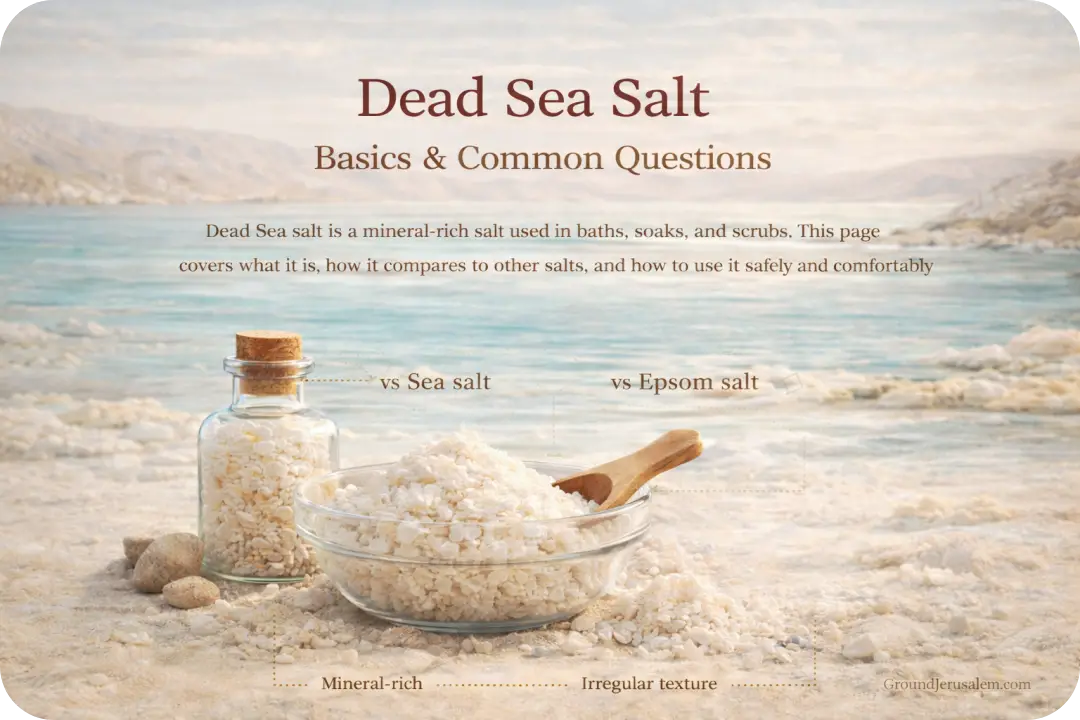
Dead Sea salt is a mineral-rich salt used in baths, soaks, and scrubs. This page covers what it is, how it compares to other salts, and how to use it safely and comfortably at home.
Quick navigation
- How is Dead Sea salt different from regular sea salt?
- Is Dead Sea salt the same as Epsom salt?
- What are the benefits of Dead Sea salt for the skin?
- Can Dead Sea salt help with rough, bumpy skin (like keratosis pilaris)?
- Can Dead Sea salt help with itchy or irritated skin?
- Why does Dead Sea salt sting on some areas?
- Can I use Dead Sea salt on the face?
- Is Dead Sea salt safe for daily use?
- Can I use Dead Sea salt for foot soaks and cracked heels?
- Can Dead Sea salt help the scalp or dandruff?
How is Dead Sea salt different from regular sea salt?
Regular sea salt is mostly sodium chloride. Dead Sea salt contains a wider mix of minerals in addition to sodium chloride, including magnesium, potassium, and calcium. Because of that mineral profile, it’s mainly used for skincare and bathing rather than cooking.
Is Dead Sea salt the same as Epsom salt?
No. Epsom salt is magnesium sulfate (one specific mineral compound). Dead Sea salt is a blend of different mineral salts, not just one. Both are used for baths, but they’re not interchangeable in composition.
What are the benefits of Dead Sea salt for the skin?
In a bath or soak, it can help soften skin and support a smoother feel. As a scrub (used gently), it can help exfoliate dead skin on the body. Many people use it as a simple at-home “spa” step, then rinse and moisturize.
Can Dead Sea salt help with rough, bumpy skin (like keratosis pilaris)?
It may help some people by gently exfoliating rough surface buildup on the body. Start with a mild approach (short soaks or very gentle scrubbing) and follow with moisturizer. If your skin gets irritated or more inflamed, stop and switch to a gentler routine.
Can Dead Sea salt help with itchy or irritated skin?
Some people find mineral salt baths soothing, especially when skin feels dry or uncomfortable. Keep the concentration moderate and rinse off afterward, then moisturize. If the salt water stings or makes irritation worse, stop using it.
Why does Dead Sea salt sting on some areas?
Salt can sting on broken, freshly shaved, or very irritated skin, including tiny cuts you may not notice. It can also sting if it gets near eyes or other sensitive areas. If you feel burning (not mild tingling), rinse off with fresh water and discontinue use.
Can I use Dead Sea salt on the face?
Use caution. Coarse salt crystals can be too abrasive for facial skin, and you should keep salt away from the eyes. If you want to try it, choose a face-formulated product or use a very diluted rinse, and stop if you get irritation.
Is Dead Sea salt safe for daily use?
For most people, daily salt baths or salt scrubbing is more than you need and can feel drying. Many use it occasionally (for example, a few times per week or less) and adjust based on how their skin responds. Always rinse and moisturize after.
Can I use Dead Sea salt for foot soaks and cracked heels?
Yes, many people use it as a warm foot soak to soften rough areas. After soaking, dry your feet well and apply a rich moisturizer to help maintain softness. Avoid soaking if you have open cracks or broken skin that stings in salt water.
Can Dead Sea salt help the scalp or dandruff?
It may help by loosening buildup and gently exfoliating the scalp when used carefully. The simplest option is a scalp product (like a shampoo or scrub) made for this purpose, and you should rinse thoroughly. If your scalp is irritated or stings, stop and avoid abrasive scrubbing.