
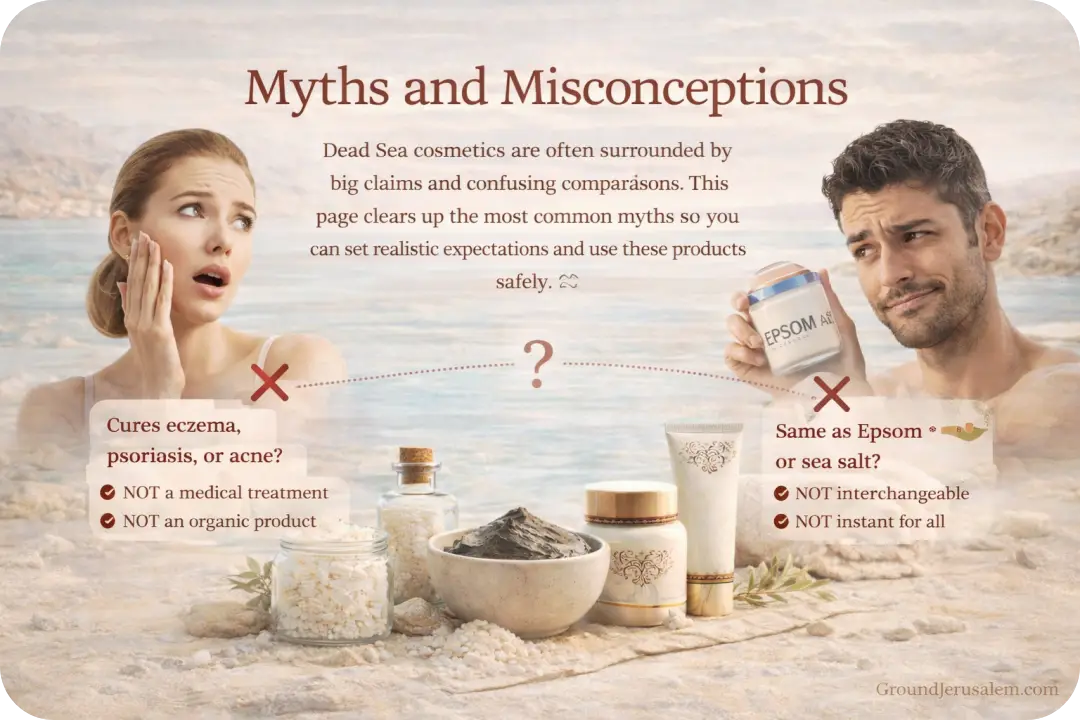
Dead Sea cosmetics are often surrounded by big claims and confusing comparisons. This page clears up the most common myths so you can set realistic expectations and use these products safely.
Quick navigation
- Are Dead Sea cosmetics a medical treatment?
- Can Dead Sea products cure eczema, psoriasis, or acne?
- Does “Dead Sea” mean a product is automatically organic and chemical-free?
- Are all Dead Sea products the same quality?
- Is Dead Sea salt the same as regular sea salt for skincare?
- Is Dead Sea salt the same as Epsom salt for baths?
- Can Dead Sea salt be eaten or used for cooking?
- Do Dead Sea products work instantly for everyone?
- Is using more mud or salt always better?
- If it tingles, does that mean it’s working or irritation?
Are Dead Sea cosmetics a medical treatment?
No. They are cosmetic products that can support cleansing, exfoliation, hydration, and comfort, but they are not a substitute for medical care. If you have a diagnosed skin condition, treat Dead Sea products as a gentle add-on and follow professional advice for the condition itself.
Can Dead Sea products cure eczema, psoriasis, or acne?
No. Some people find Dead Sea salt or mud helps ease symptoms like dryness, itch, or redness, but results vary and it is not a cure. If symptoms are severe, worsening, or persistent, it is reasonable to consult a dermatologist.
Does “Dead Sea” mean a product is automatically organic and chemical-free?
No. Many Dead Sea products highlight natural minerals or mud, but formulations can still include standard cosmetic ingredients like preservatives, added oils, or fragrance. Always check the ingredient list instead of assuming “Dead Sea” equals organic.
Are all Dead Sea products the same quality?
No. Products vary by how much Dead Sea mineral content they use, how they are processed, and what else is added to the formula. If you have sensitive skin, simpler formulas with fewer added irritants are often easier to tolerate.
Is Dead Sea salt the same as regular sea salt for skincare?
No. Regular sea salt is mostly sodium chloride, while Dead Sea salt contains a wider mix of minerals like magnesium, potassium, and calcium. That mineral profile is why Dead Sea salt is used for skincare rather than as a basic “salt” ingredient.
Is Dead Sea salt the same as Epsom salt for baths?
No. Epsom salt is magnesium sulfate, while Dead Sea salt is a blend of different mineral salts. Both are used for baths, but they are not interchangeable ingredient-for-ingredient.
Can Dead Sea salt be eaten or used for cooking?
No. Dead Sea salt is not food-grade and is generally intended for external use only. Use it for baths or skincare, not as a seasoning.
Do Dead Sea products work instantly for everyone?
No. Some people notice smoother-feeling skin after a single use, while others see gradual changes over weeks, and some may not notice much. Your skin type, how often you use the product, and the formula all affect the outcome.
Is using more mud or salt always better?
No. Using mud masks or salt scrubs too often can lead to dryness or irritation, especially on sensitive skin. Start with lower frequency and increase only if your skin stays comfortable.
If it tingles, does that mean it’s working or irritation?
A mild, brief tingling or warmth can be normal, especially with mineral-rich mud or salt. Burning, stinging that feels sharp, swelling, or redness that lasts is a sign to rinse it off and stop using that product. If you are unsure, patch test first and consider asking a professional for guidance.